Magnetron jammers - the AN/APT-4
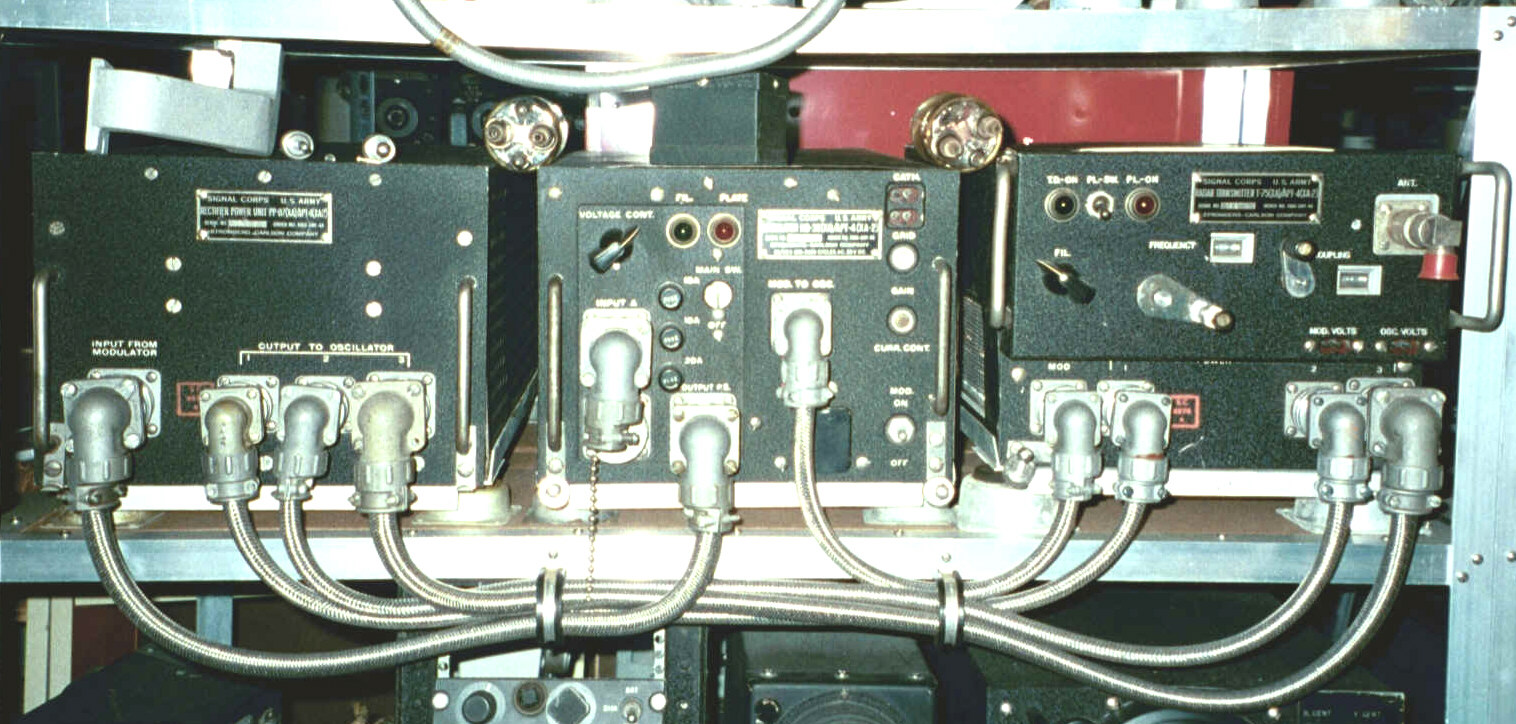
This jammer, code named Broadloom I, was the first to use one of the techniques feverishly explored in the middle of the
war to raise power outputs at VHF and UHF frequencies. Faced with the inability to use
conventional triodes and tetrodes at power levels of more than 20 or 30 watts output, this transmitter
was designed to use an early 1930s development - a split anode magnetron - to obtain 150W
CW output from about 140 MHz to almost 800 MHz. They used two different tubes to
cover this frequency range , along with an impressive amount of hardware devoted to the care
and feeding of this simple(!) one tube transmitter. These tubes differed from the more familiar cavity magnetrons used for
pulse radar work in that they used an external resonant LC circuit, sometimes called a tank, to provide an impressive tuning range.
Composed of three separate packages - left to right a power supply, an AM modulator using a pair of 813 PA tubes,
and the transmitter - this prototype set by Stromberg Carlson had a production run of only 100 sets.
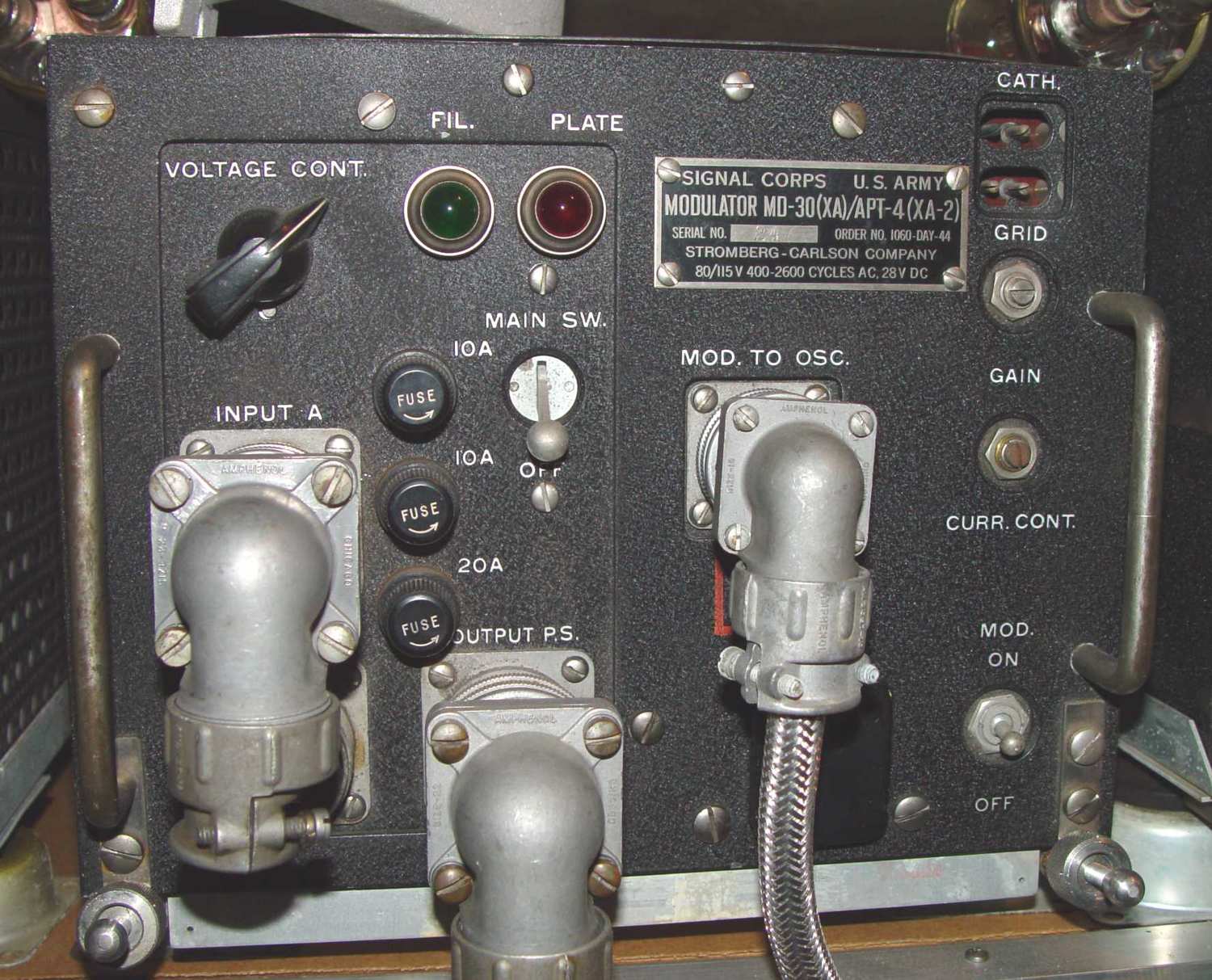
Closeup of Modulator
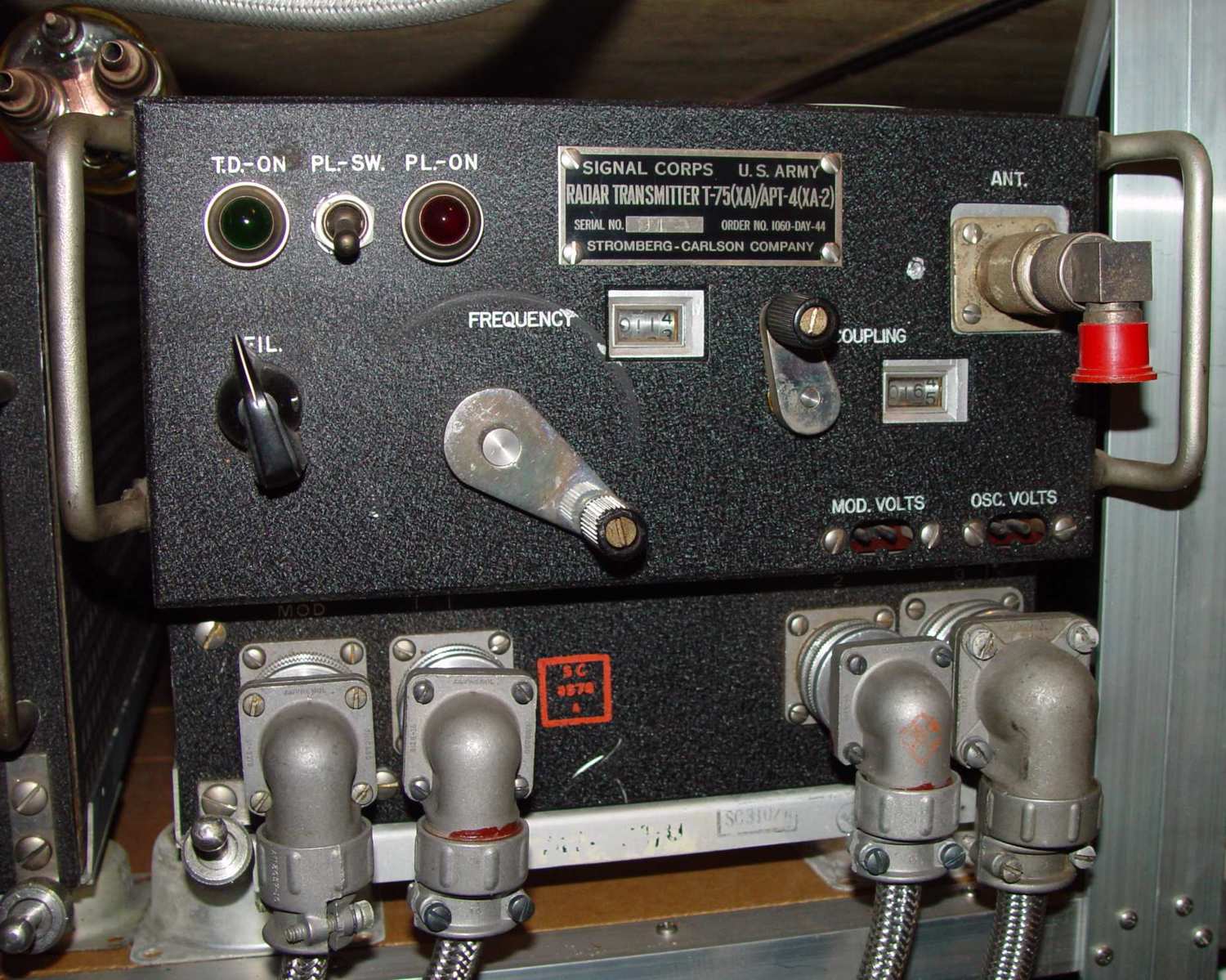
Closeup of Transmitter
GE was selected to manufacture the final product, and there are small changes between this rare example and the
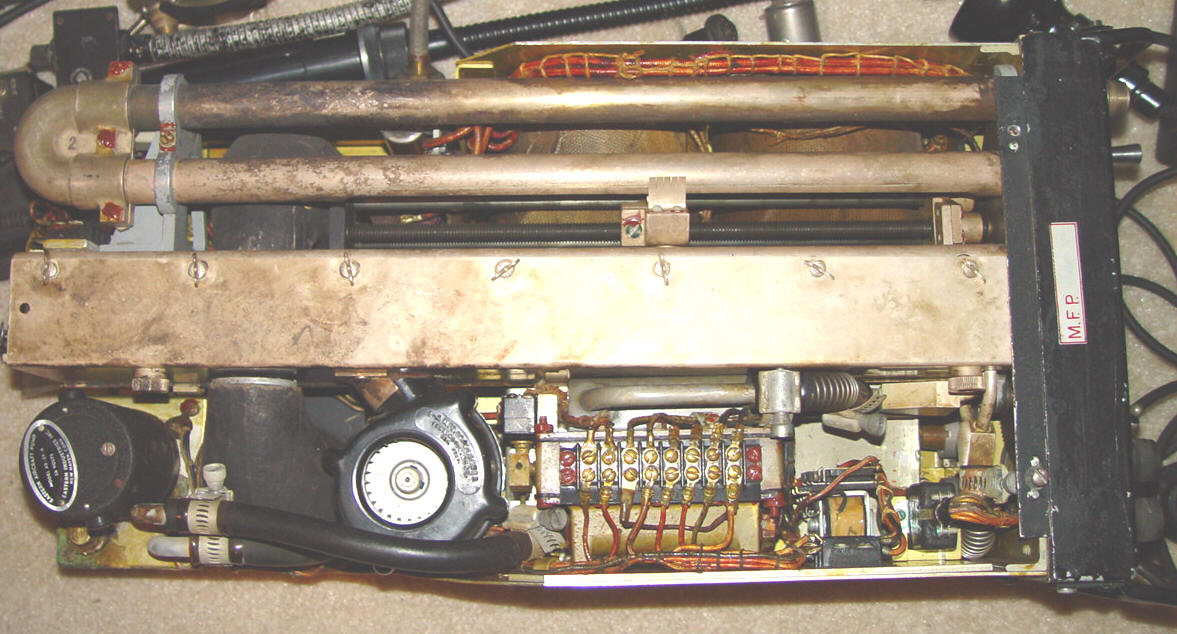
later GE set that had an initial production of 2,092 sets. Below is a photo of the interior of
the GE transmitter, showing the long tuning cavity and coaxial line stretcher "trombone" used
to get the frequency down to its surprising low end of 2 meters.
There was a serious filament "back heating" problem that plagued the early developers (analogous
to thermal runaway in a transistor circuit), Initial operation with the split anode tube ran into an impractically short lifetime
of less than 30 hours for the tube. It seems that you have essentially a miniature
cyclotron at work in the tube, and especially at frequencies below about 150MHz,
electron leakage from the anodes bombarding the glass seals was causing the
early failure. Eventually, the simple addition of washers and nuts above the seals deflected
the electrons from the seals enough to make the tubes last ten times as long.
Even so, there is an impressive amount of heat to
be carried away from an operating tube, and this package is filled
with electric motors to accomplish that task - three blowers (two to blow air through the glycol cooled radiator used to
keep the tube temperature down), as well as a coolant pump at lower left. The recirculation method
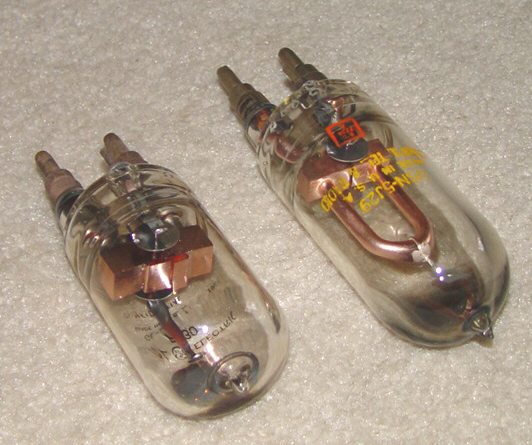
depended on which of the two magnetrons was used. The lower frequency magnetron at left below
required coaxial brass tubes to circulate pure glycol deep into each anode of the magnetron,
recovering the hot fluid coming back out in the outer brass tube. The higher frequency
tube had a continuous loop through the tube, so circulation wasn't quite so difficult
a problem and could recover more heat in operation. Changing magnetron types on the Stromberg Carlson prototype required turning a
valve 90 degrees, while the later
GE set accomplished the same thing through the tube attachments. Below is a closeup of both tubes - a 5J30
on the left and 5J29 on the right.
Return to Countermeasures Index